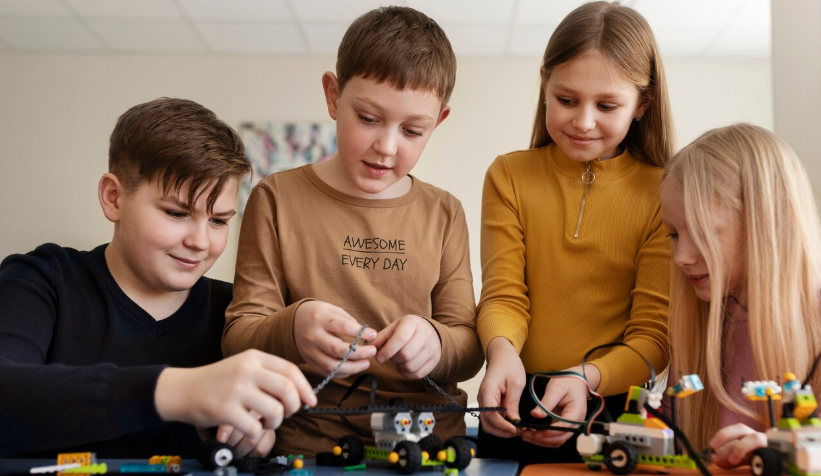
Modern learning increasingly focuses on helping students explore ideas through creativity, collaboration, and practical activities. LEGO Education brings these elements together by using familiar building materials and technology to support classroom learning. Instead of relying only on lectures or written exercises, students can build models, test ideas, solve problems, and improve their designs. This approach can make lessons more interactive while encouraging learners to participate actively in the learning process. Building-based activities can also connect subjects such as science, technology, engineering, mathematics, and computer science with practical challenges that students can explore individually or in groups.
What Is LEGO Education?
LEGO Education is an educational approach and product ecosystem designed to support learning through construction, experimentation, and problem solving. It combines physical building materials with learning activities that can be used across different age groups.
Students may create structures, machines, robotic models, or other projects while following lesson objectives. The building process allows learners to see how different parts work together. When a design does not function as expected, students can modify it and try again.
This process encourages learning through experimentation rather than simply looking for one correct answer. Teachers can use these activities to introduce concepts and then allow students to explore those concepts through practical tasks.
Learning Through Building
Building can provide students with a direct way to explore abstract ideas. A lesson about balance, for example, can involve constructing a structure and observing how changes affect stability. Similarly, mechanical concepts can be explored by creating models with moving parts.
The physical nature of these activities can help students connect classroom concepts with visible results. They can observe what happens when they change a component, adjust a design, or introduce a new idea.
This type of learning can also encourage students to become comfortable with experimentation. Making a mistake becomes part of the process because learners can identify the problem, make adjustments, and test the result again.
Supporting STEM Learning
Science, technology, engineering, and mathematics are important areas where building-based learning can be especially useful. Students can explore engineering principles by designing structures, mechanisms, and automated models.
In science lessons, models can help demonstrate movement, energy, ecosystems, or other concepts. Technology activities can introduce programming and computational thinking. Mathematics can be incorporated through measurement, patterns, angles, quantities, and problem solving.
Connecting several subjects within one project can help students see relationships between different areas of knowledge. Rather than treating each subject as completely separate, project activities can demonstrate how scientific and mathematical ideas are used in technological and engineering applications.
Robotics and Coding Activities
Robotics can add another dimension to hands-on learning. Students can construct a model and then use programming concepts to control its behavior.
Coding activities may introduce ideas such as sequences, conditions, loops, variables, and logical problem solving. Students can begin with simple instructions and gradually work toward more complex tasks.
The combination of construction and coding can make programming more tangible. Instead of seeing code only on a computer screen, students can observe how their instructions affect a physical model.
When a robot does not behave as expected, learners can investigate the code, examine the construction, and determine where changes are needed. This creates opportunities for debugging and systematic thinking.
Developing Problem Solving Skills
Problem solving is a central part of project-based learning. Students may receive a challenge without being given every step needed to complete it.
They must interpret the problem, consider possible solutions, build a model, test it, and make improvements. This process develops persistence and encourages learners to think about why a particular solution works or fails.
For example, a classroom challenge might ask students to build a structure that can support a specific amount of weight. Different groups may create different designs. Comparing those designs can lead to discussions about stability, materials, structure, and efficiency.
Such activities can also show students that complex problems may have several possible solutions.
Encouraging Creativity
Creativity is not limited to art and writing. Engineering and technology also require people to imagine new possibilities and develop original solutions.
Building activities give students opportunities to experiment with shapes, mechanisms, structures, and designs. They can take an initial idea and modify it according to their observations.
Open-ended projects can be particularly useful because they allow students to make decisions about how their final product will work or look. Teachers can provide a clear learning goal while giving students flexibility in how they reach it.
This balance between structure and creativity can make classroom projects more engaging.
Collaboration in the Classroom
Many building and robotics projects are suitable for teamwork. Students can work together to plan a design, divide responsibilities, test models, and discuss improvements.
Group projects can encourage communication because students need to explain ideas and listen to different perspectives. They may also learn how to handle disagreements and reach decisions collectively.
Teachers can assign different responsibilities within a project, such as designer, builder, programmer, recorder, or tester. Roles can be rotated so students experience different parts of the process.
Collaboration also allows students to learn from classmates. One student may have an idea for construction while another may identify a programming solution.
The Role of Teachers
Teachers remain an important part of hands-on learning. Building materials and technology do not replace instruction. Instead, they provide additional tools that teachers can use to create meaningful learning experiences.
A teacher can introduce the relevant concept, explain the challenge, ask questions, monitor progress, and encourage students to reflect on their results.
Instead of immediately correcting a problem, teachers can ask questions that guide students toward their own solutions. Questions such as “What changed when you moved this part?” or “Why do you think the model stopped?” can encourage deeper thinking.
This approach positions the teacher as a guide while students take an active role in exploring the lesson.
Benefits for Different Learning Styles
Students do not all engage with information in the same way. Some learners may benefit from seeing concepts demonstrated, while others may learn effectively by interacting directly with materials.
Hands-on activities can provide another pathway for exploring classroom concepts. Students can see, touch, build, test, and modify their work.
This does not mean that one teaching method works for every learner. Instead, practical projects can complement reading, writing, discussion, demonstrations, and other classroom strategies.
Using different instructional approaches can give students more opportunities to participate and demonstrate what they have learned.
Project Based Learning
Building projects can fit naturally into project-based learning. Students can work toward a defined goal over several lessons while applying knowledge from different subjects.
A project might involve designing a transportation system, creating a structure, programming an automated device, or investigating how a particular mechanism works.
Students can document their process, explain their decisions, and present their finished work. This makes the final product only one part of the learning experience.
The planning, testing, revision, and presentation stages can also provide opportunities for assessment. Teachers can evaluate both the final result and the reasoning students used to reach it.
Preparing Students for Future Skills
Schools increasingly emphasize skills such as communication, collaboration, creativity, critical thinking, and digital literacy. Practical projects can provide opportunities to develop several of these abilities at the same time.
Students who regularly work through design challenges may become more comfortable with testing ideas and responding to unexpected results. Coding and robotics activities can also introduce computational thinking that may be useful in later academic or career settings.
The goal is not simply to teach students how to build a particular model. More importantly, activities can encourage learners to develop transferable ways of thinking that can be applied to new situations.
Using Technology Alongside Physical Materials
One feature of modern educational tools is the combination of physical construction with digital resources. Students can interact with physical models while using software for programming, instructions, simulations, or documentation.
This combination can make technology more interactive. Students are not only consuming digital information but also using technology to create and control something tangible.
Digital tools can also support experimentation. A student may change a program, run the model, observe the result, and then revise the instructions. This creates a practical feedback cycle.
Assessment and Student Reflection
Assessment does not always have to focus on a written test. Practical projects can provide teachers with additional ways to evaluate learning.
Students can explain how their model works, describe challenges they encountered, and discuss the changes they made. Teachers can assess whether students understand the concepts behind their designs.
Reflection is particularly useful because it encourages learners to think about their own process. Questions about what worked, what failed, and what could be changed can turn a building activity into a deeper learning experience.
Frequently Asked Questions
What is LEGO Education used for?
It is used to support hands-on learning through building, problem solving, robotics, coding, and project-based activities across subjects and age groups.
Can it be used for STEM subjects?
Yes. Building and robotics projects can support science, technology, engineering, and mathematics concepts through practical activities.
Does LEGO Education teach coding?
Some educational activities incorporate programming and robotics, allowing students to learn coding concepts while controlling physical models.
How does building help students learn?
Building allows students to experiment with concepts, observe results, identify problems, and make changes. This can reinforce theoretical knowledge through practical experience.
Can students work in groups?
Yes. Many project activities can be completed collaboratively, giving students opportunities to communicate, divide responsibilities, and develop solutions together.
Is hands-on learning suitable for younger students?
Hands-on activities can be adapted for different age groups. Younger learners can work with basic construction and problem-solving tasks, while older students can explore advanced robotics, engineering, and programming concepts.
Conclusion
Hands-on learning can give students meaningful opportunities to explore concepts rather than simply memorize information. Building, coding, robotics, teamwork, and project challenges can bring classroom subjects together in practical ways. LEGO Education supports this style of learning by giving teachers tools and activities that encourage experimentation, creativity, and problem solving. When integrated with effective teaching strategies, these activities can help students connect academic concepts with real-world applications while developing skills that extend beyond a single classroom project.
Pingback: Minecraft Education Mods and How They Enhance Learning - Classroom Mindset